

When it comes to boosting your website’s visibility on search engines, one of the most important components is your metadata description length information—specifically, the SEO title (title tag) and meta description.
At Nexdat, we understand that “meta” refers to data about your page, and in SEO, it’s the title and description tags that matter most. These tags are small pieces of HTML code that tell search engines what your page is about and influence how your content appears in search results.
Your title tag and meta description not only help search engines index your site correctly, but they also impact whether users click on your link. Well-crafted meta tags can significantly increase your click-through rate and drive more traffic to your website.
If you are unsure how to write your SEO titles, tags and meta descriptions for better search visibility and click-through rates, you’ve come to the right place. At Nexdat, we’re here to guide you. Crafting meta tags that perform well requires a balance:
Creating SEO titles and meta descriptions that get more clicks requires a two-fold approach. First, you need to understand the technical part of website and best practices that make the search engines happy. Second, you need to actually craft clickable copy that your audience wants to read.
Our goal is to help you approach SEO strategically, so your content not only ranks higher but also gets clicked by the right audience. At Nexdat, we’re diving into both sides of the SEO equation—how to technically optimize your titles and meta descriptions for search engines, and how to craft them in a way that captures real attention.
What is an SEO Title Tag?
An SEO title tag is an essential HTML element that serves as the clickable headline users see in search engine results pages (SERPs). It plays a critical role in helping both search engines and users understand what a webpage is about.
Appearing as the blue text at the top of every organic listing, the title tag is one of the most impactful on-page SEO elements. A well-optimized metadata description length or title tag can boost your rankings, increase click-through rates (CTR), and improve your site’s overall visibility in search results.
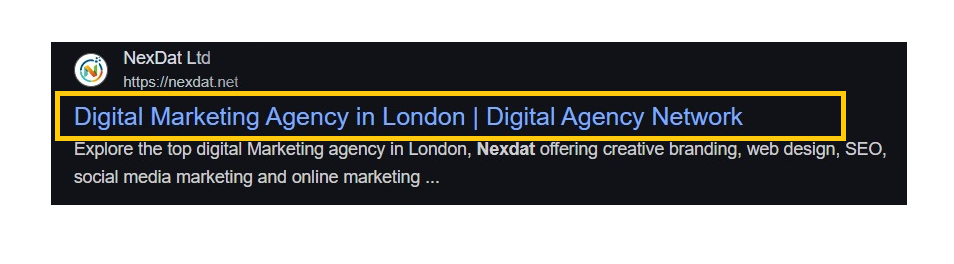
At Nexdat, we help you craft SEO titles that not only meet technical best practices but also compel users to click.
This information is present in the SERPS as the blue text at the top of every organic result.
How to Structure and Format Your SEO Title
Crafting an effective SEO title starts with strategic keyword targeting and clean structure. Every page on your website should focus on a unique target keyword, or at most two to three closely related ones. Avoid having multiple pages targeting the same or similar keywords in their SEO titles or H1s—doing so can split your traffic and dilute your page’s ability to rank effectively.
Your homepage is your most powerful asset when it comes to SEO. It typically holds the highest Page Authority (PA) and is often the best candidate to rank for your main or most competitive business keyword. This is especially important for new websites, where optimising the homepage with your top-level keyword in the metadata description length or can say title tag and description sets the tone for your entire SEO strategy.
Rank Higher, Faster – Talk to Nexdat’s SEO Experts
From a formatting perspective, always aim to:
- Place your primary keyword as close to the beginning of the title tag as possible. Google has confirmed that it gives slightly more weight to the first few words in a title tag.
- This placement also aligns with how users read—left to right—making your keyword more visible and improving the likelihood of a click.
At Nexdat, we ensure every SEO title is crafted to meet both search engine standards and user expectations, helping your pages perform at their best.
How To Write Title Tags That Get Clicked – Best Practices for 2025
At Nexdat, we know that getting your site noticed means going beyond technical accuracy. It’s not just about crafting a title tag that works for search engines—it’s about writing headlines that real people want to click.
Here are the most effective title tag writing strategies for 2025:
Keep it within 60 characters.
Use pipes ( | ) or hyphens ( – ) to break up text
Include relevant modifiers and long-tail keywords
Write for humans, not just bots
Never skip the basics
Be creative and compelling
What are Meta Descriptions?
An SEO meta description is an HTML tag that offers a concise summary of a webpage’s content. It appears just below the title tag in search engine results and plays a key role in improving your click-through rate (CTR).
While meta descriptions don’t directly impact your site’s rankings, they can significantly influence whether a user decides to click on your link. In many ways, it’s your first impression—a short snippet that convinces someone your page is worth visiting.
For Nexdat and our clients, crafting an effective meta description is a vital part of every web development and digital marketing strategy. A strong, relevant description can be the difference between getting ignored and generating leads.
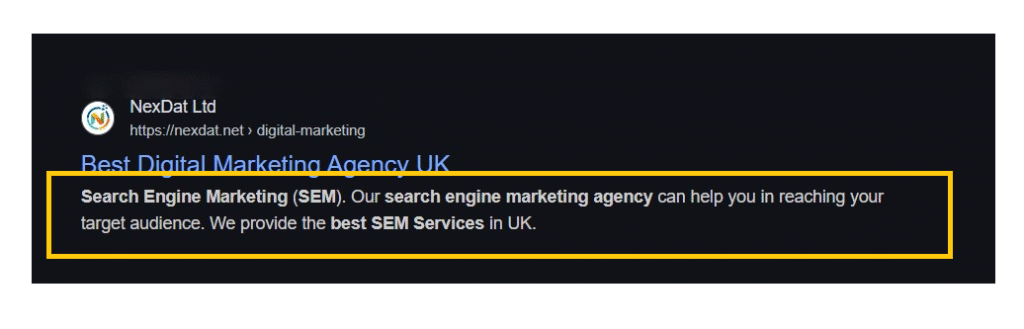
How To Write Meta Descriptions That Get Clicked
A well-crafted meta generator acts like a mini advertisement for your web page. While it doesn’t directly influence search rankings, it plays a vital role in improving your click-through rate (CTR). Here’s how to write one that drives real results in 2025:
Google typically displays up to 150–160 characters, so make the most of this space. Be concise yet informative—every word should serve a purpose.
Incorporate your brand name, primary keyword, and, if possible, a secondary keyword or target location. These keywords often appear bolded in search results, helping catch a searcher’s eye and boosting relevance.
Encourage users to take the next step with phrases like “Learn more,” “Shop now,” or “Get a free quote.” A compelling CTA can increase the likelihood of a user clicking your link over competitors.
Your meta description is your chance to pitch your page before the user even lands on it. Focus on value, clarity, and what makes your brand or offering unique.
Google doesn’t always display the meta description you provide. If it finds content on your page that better answers a user’s query, it may pull that instead. That’s why writing a contextual, relevant, and audience-focused description is key—so you increase the odds of Google using your version.
Tailor your message to match your target industry, audience expertise level, and search intent. The more aligned your content is with the searcher’s needs, the higher the engagement.
Conclusion
The title tag is still a ranking factor. According to Moz’s latest research, Title tags are “the second most important on-page factor for SEO”. With that being said, title tags are no longer as primarily effective as they once were, and spamming keywords into the title will likely yield no positive results.
Meta description is not a direct ranking factor, but can indirectly lead to higher search visibility through increased engagement.
If you’re serious about growing your online presence, let Nexdat help. Whether you need expert content review, full-scale SEO optimization, or a broader digital strategy, we’ve got you covered.